Beginner’s Pitfall Guide: Practical Thinking and Path Selection for Multi‑Platform Content Distribution

In today’s content‑first world, simply creating a great article is far from the end goal. The real challenge often begins after “publishing”—how to break the limits of a single platform, reach a broader audience, and build a sustained influence loop? For many newly‑starting content creators or SaaS startups, this is a sea full of temptations but also riddled with hidden reefs.
The Dream: One Creation, Whole‑Web Bloom
“One publish, synchronized across the web” is an extremely attractive slogan. It promises ultimate efficiency and liberation of time and effort. Beginners usually harbor this vision: after carefully writing a blog on a primary platform, a single click makes the content automatically adapt to the formats of major platforms and appear on Medium, LinkedIn, Zhihu columns, CSDN, personal independent sites, and various social media. It sounds like a perfect growth lever.
However, in real operational environments, this ideal quickly hits reality. We once tried manual cross‑platform distribution; the first few weeks were full of enthusiasm. Soon, the team was bogged down by tedious repetitive work: adjusting image sizes for each platform, rewriting titles to match different community tones, handling platform‑specific Markdown or rich‑text formats, managing a pile of account login states… This not only consumed a lot of time that could have been spent creating, but also turned publishing into a burden, severely dampening the motivation for continuous output.
The Harsh Reality: Platform Rules and the Abyss of “Format Adaptation”
The biggest pitfall of multi‑platform distribution is not technology but “people” and “rules.” Each content platform is an independent ecosystem with its own community culture, recommendation algorithm, and explicit/implicit rules. Throwing the same content unchanged at every platform often yields unsatisfactory results, sometimes even counterproductive.
For example, readers on technical communities expect clear code snippets and deep architectural analysis, while on a professional social network like LinkedIn, people prefer concise, conclusion‑first pieces that emphasize industry insights and career value. More tricky are platform rules: some platforms forbid external links, others are extremely sensitive to marketing content, and direct synchronization can trigger review mechanisms, leading to throttling or bans. We learned this the hard way: an industry analysis that performed well on an independent site was flagged as excessive marketing when synchronized to a certain social media because it contained product‑feature links, causing a sharp traffic drop for that channel.
Therefore, a key insight is: True “distribution” is not mindless “synchronization.” It requires a pre‑distribution “localization” process, which pure automation tools cannot fully cover.
Tools Enter the Scene: Automation Takes Over the Tedious “搬运” Work
After the exhausting period of manual distribution, we started looking for tool assistance. The goal was clear: not to expect an “AI” to think about copy strategies for each platform, but to have a reliable “automation assistant” to handle the repetitive, mechanical, error‑prone “搬运” and “publish” steps.
That’s why SEONIB Flow entered our workflow. Its positioning is very clear: a distribution hub deeply integrated into the content creation workspace. Our usage adjusted accordingly. Creation still happens in Notion or Google Docs, where deep thinking and editing occur. After finalizing, we import the final version into SEONIB Flow.
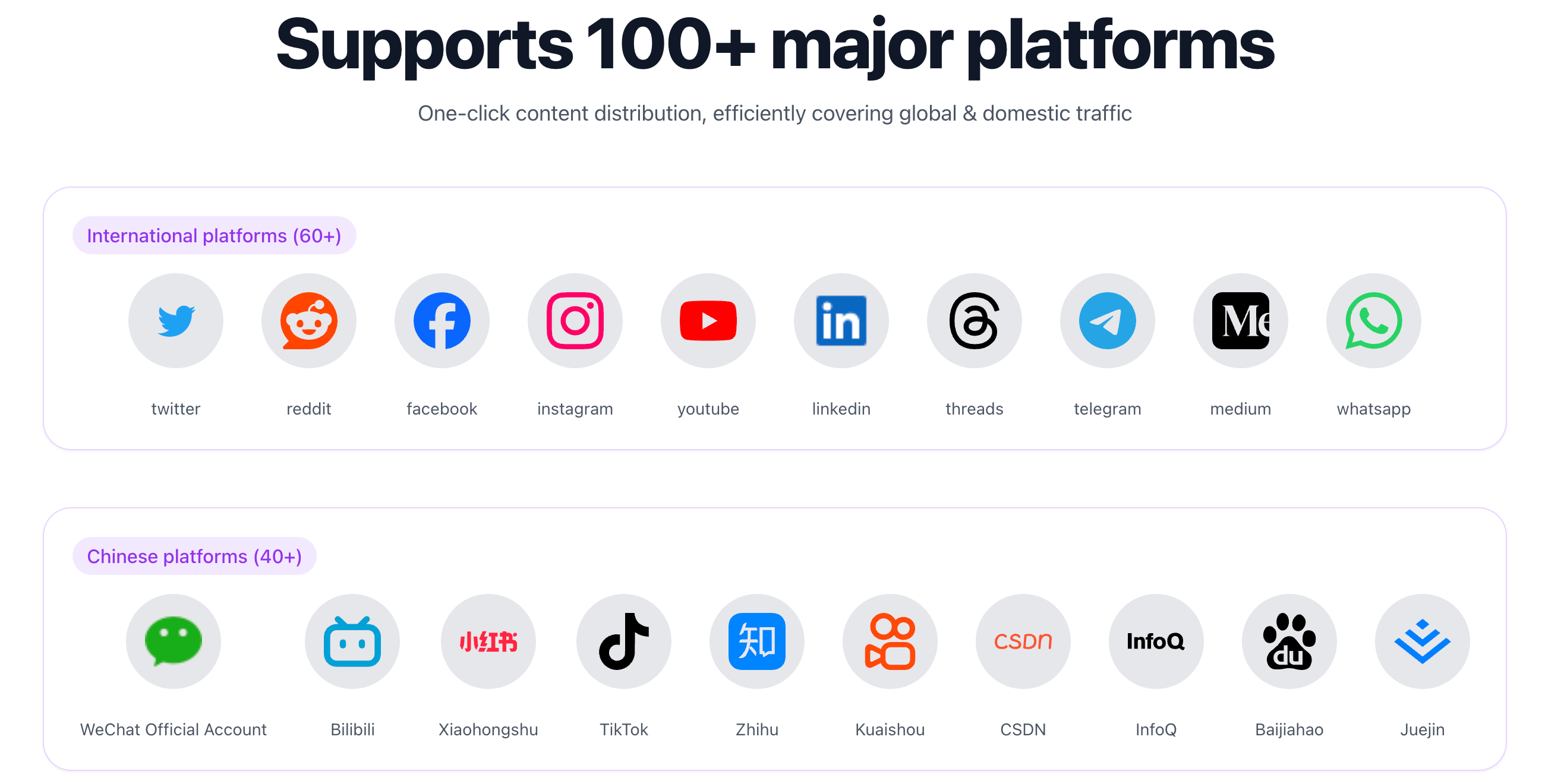
Its core value lies in pulling us out of the swamp of “multiple logins, manual copy‑pasting, format adjustments.” With one click, it pushes content to the backend publishing interfaces of dozens or even hundreds of preset platforms. More importantly, it performs basic format adaptation according to each platform’s technical specifications, such as converting Markdown to platform‑compatible rich text or adjusting popular image dimensions.
The Crucial “Final Confirmation”: Human‑Machine Collaboration Safety Valve
It is necessary to emphasize a key limitation in SEONIB Flow’s design, which we view not as a flaw but as a responsible feature: it does not have the ability to intelligently rewrite content based on each platform’s characteristics, and requires the user to confirm before final publishing.
Initially, we thought this “confirmation” step was redundant, seeming to prevent “full automation.” But a near‑miss publishing incident quickly changed our view. At that time, a piece of content was mistakenly selected for a vertical community account we had already decided to pause. If the system had auto‑published, it would have sent an ill‑timed, potentially brand‑damaging post to that community. The “final confirmation” stage gave us the chance to perform a last check and avoid the mistake.
This design profoundly reflects the proper relationship between tool and human. The tool handles deterministic, high‑repeatability tasks (format conversion, batch submission), while humans control strategic, nondeterministic core steps (tone, platform selection, compliance review). Delegating the ultimate responsibility for account security and content compliance to the user shows the highest respect for platform rules and user accounts. It also forces the team to develop a healthy habit: spend a minute reviewing each platform’s preview before clicking “Confirm.”
Redefining “Distribution”: Process Optimization and Mental Liberation
After introducing tools like SEONIB Flow, our content distribution process underwent a qualitative change. It didn’t achieve a “one‑click global exposure” magic, but it accomplished something more valuable: reducing the friction cost of content distribution to a minimum.
Now the team’s workflow is: deep creation → final draft → import into distribution flow → fine‑tune titles and introductions per platform (still manual but done in a unified interface) → one‑click submission to each platform’s backend → final check and confirm publishing. The entire process shrank from several hours to 15‑30 minutes.
The biggest gain is not time itself but mental liberation. Creators no longer dread “distribution”; they can focus more on creation. Moreover, with the lowered publishing barrier, we can more comfortably conduct A/B tests, e.g., distributing the same core content with different titles and openings to different platform types, observing feedback, and iteratively optimizing our content strategy.
Core Advice for Beginners: Start with Strategy, Not Tools
Looking back, our advice for newcomers is:
- Strategy first, tools later: Don’t start by hunting for a “universal distribution tool.” First identify the 2‑3 core platforms where your main audience resides and concentrate on them. Once your content model stabilizes on those platforms, consider extending mature content to other platforms for added value.
- Understand the real meaning of “adaptation”: Tools can solve “technical format adaptation,” but they cannot solve “cultural context adaptation.” The former can be automated; the latter must rely on human judgment. Always prepare a “special edition” for your most important platform.
- Use tools to lower execution cost: When you need to manage more than three platforms, consider a tool like SEONIB Flow to take over publishing actions. Its value lies not in replacing your thinking but in freeing you from repetitive labor so you can focus on higher‑level strategic issues.
- Treat “final confirmation” as an essential step: No matter how smart the tool, keep a final human check. This is the most basic protection for your account assets.
Multi‑platform distribution is ultimately a balance between “efficiency” and “effectiveness.” Good tools don’t make you stop thinking; they save you precious energy so you can concentrate on where, to whom, and how to say it better.
FAQ
Q1: As a beginner, should I register on all platforms and start distributing immediately?
No. Don’t bite off more than you can chew. Early on, focus on 10‑20 core platforms that best match your target audience (e.g., LinkedIn and industry vertical communities for B2B products). Build influence and understand the mechanics there, then use tools to extend verified content to other platforms. This yields higher success rates and lighter management burden.
Q2: Will automatic distribution cause platforms to flag my content as low‑quality or duplicate?
If you simply copy‑paste the entire article, that risk exists. The key is “pre‑processing.” Even when using a distribution tool, you should customize titles, opening hooks, and tags for major platforms (e.g., Zhihu, Toutiao) so the content appears “tailored” rather than a plain搬. The tool ensures “delivery,” but the quality and relevance of the content still require human oversight.
Q3: Do I need completely different content for each platform? Doesn’t that increase workload?
Balance is needed. We don’t recommend rewriting every piece, but we suggest “structural adjustments.” For example, extract core points from a long blog, add different examples, and turn it into a short graphic post for social media (Weibo, Twitter); or reorganize tutorial steps and conclusions into a Q&A format suitable for Stack Overflow‑style communities. The distribution tool handles the publishing action, while planning these “derived pieces” should be part of your content strategy.
Q4: When using a one‑click distribution tool, how can I ensure the safety of each account?
When choosing a tool, pay close attention to its authorization mechanism and compliance design. Reliable tools typically use official OAuth, do not store your passwords, and, like SEONIB Flow, return final publishing confirmation to the user. This gives you a chance to verify content and platform before publishing. Never use tools that ask for your account passwords and promise fully automatic, intervention‑free publishing; the risk is extremely high.
Q5: After multi‑platform distribution, how do I track performance?
This is the crucial post‑distribution step. Don’t focus only on the act of publishing. Leverage each platform’s built‑in analytics dashboards or use unified UTM parameters to track traffic back to your independent site or core landing page. Observe traffic quality, dwell time, and conversion rates from different platforms. These data will tell you which platforms deserve deeper localization effort and which are only suitable as supplemental brand exposure channels.
Share Article