Multi‑channel Publishing: Why It’s the Decisive Factor for SEO Traffic Growth in 2026
There was a time when we thought SEO was just writing a good blog post, optimizing on‑site tags, and waiting for Google’s favor. Then we poured massive resources into producing a series of what we considered high‑quality long‑form articles, only to see traffic growth remain stagnant like a dead pond, even slipping slowly as competition for core keywords intensified. It felt like preparing an elaborate dinner that no one attended.
What went wrong? After months of data review, we uncovered a harsh reality: in today’s information‑overload, platform‑fragmented world, a single website acting as a content “island” is discovered and gains authority far slower than we expected. Google’s crawler is powerful, but building trust in a new site or new content takes time and, more importantly, “votes” from other authoritative sites—in other words, backlinks and mentions. Waiting for those votes to happen organically in the 2026 content red sea is almost like waiting for a rabbit to appear at a tree stump.
From “Creating Content” to “Distributing Signals”
Our initial strategy was wrong. We equated “content” with “page” and “publishing” with “going live.” Search engines—especially Google, which increasingly relies on E‑E‑A‑T (Experience, Expertise, Authority, Trustworthiness)—view the world differently. They need multiple signals to verify your expertise and authority.
A typical scenario: you publish a deep analysis of “2026 SaaS Growth Models” on your corporate site. For Google, that’s a single signal source. But if the core insights of that analysis also appear on Medium, LinkedIn Pulse, relevant Reddit sub‑communities, and even a Hacker News discussion, each linking back or mentioning your original article, the situation changes. In Google’s algorithm, it’s no longer a single site talking to itself; it’s a viewpoint being discussed and validated across multiple related communities. This dramatically speeds up the trust‑building process.
We manually tried this distribution: after writing the main article, we rewrote it for different platforms—LinkedIn more professional, Reddit to spark discussion, Dev.to more technical. The results were immediate. The main site’s indexing speed, long‑tail keyword rankings, and—most importantly—direct backlinks from these distribution channels all improved significantly. However, the pain points were obvious: it was a labor‑intensive, error‑prone, and hard‑to‑scale process. A three‑person content team spent more than two days each week on distribution and format adaptation.
“Format Traps” and Compliance Risks in Scalable Distribution
When you decide to distribute a technical whitepaper across ten platforms, the first challenge isn’t “whether you can,” but “whether it’s appropriate.” Each platform has its own DNA and unwritten rules:
- LinkedIn Articles – require a more concise summary, clear industry insights, and a call‑to‑action; images must look professional.
- Medium – favors storytelling and deep reflection; tag selection directly influences recommendation traffic.
- Specific Reddit Sub‑communities – you cannot just drop a link; you must enter from a discussion‑oriented angle and even present part of the core content as text, otherwise the post is flagged as spam and removed.
- Hacker News – titles must be news‑worthy or technically interesting; blatant marketing is dead on arrival.
- Industry‑specific forums – you need to fully integrate into the forum’s context, contributing via Q&A or experience‑sharing posts.
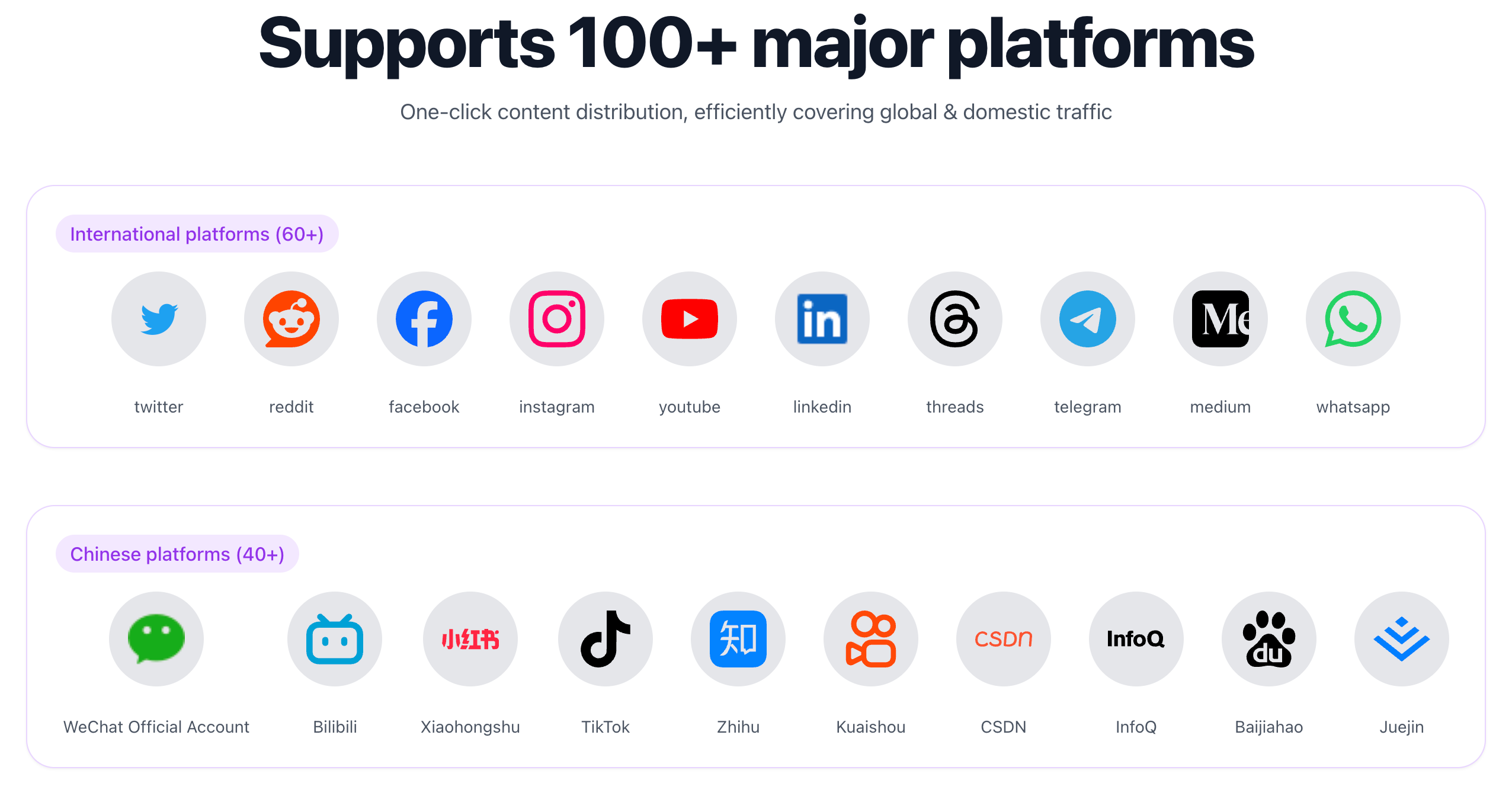
Early on, we tried to automate publishing with a series of IFTTT or Zapier workflows, which led to several “incidents.” For example, a technical article with detailed code examples was posted unchanged to a business‑focused platform that centers on opinion discussion, appearing completely out of place, generating massive negative feedback, and even hurting our brand image. Worse, some platforms have strict review mechanisms for automated content; bulk, homogeneous posts easily trigger throttling or account bans.
This made us realize that true “one‑click distribution” should not be a blunt, unprocessed sync. It should be a buffered, intervene‑capable, intelligent workflow. We need a hub that can manage all platform accounts and connections, provide basic format reminders according to each platform’s characteristics (e.g., “You’re about to post on Reddit; consider starting with a question”), but ultimately require human confirmation before publishing. This respects platform rules and protects brand safety.
That’s when we integrated our core publishing workflow into SEONIB Flow (https://flow.seonib.com). Its value isn’t in “creating” different versions of content forus—creative work can’t be automated—but in freeing us from tedious repetitive tasks and account management. I can manage the publishing status of all platforms from one place; it handles API integrations, basic format validation (character limits, image ratios), and provides a clear dashboard where I can preview each platform’s adaptation before clicking “Confirm.” This perfectly matches our need for scalable efficiency combined with manual compliance review.
Where Traffic Growth Comes From: Not Just Backlinks
Many people equate multi‑channel publishing with “link building,” underestimating its broader value. In practice, we observed traffic growth coming from four layers:
- Direct referral traffic – the most obvious. If you have 10 k followers on Medium and the platform’s recommendation engine drives 20 k reads, a sizable portion of readers will click the link to your site, becoming high‑quality direct traffic. These users tend to have deeper engagement and higher conversion intent than pure search traffic.
- Accelerated indexing and ranking signals – when your content appears simultaneously on several high‑authority platforms (Medium, LinkedIn, etc.), Google’s crawler discovers and indexes your main site faster. More importantly, the domains of those platforms provide “background support” for the core concepts you mention. We observed that core keywords from system‑distributed content entered Google’s top‑10 pages 3–7 days faster on average.
- Brand search and direct visits – multi‑channel exposure creates a side effect: increased searches for your brand name. Users who see your viewpoint across various places may not click immediately but will remember the brand or author and later search for it directly. This traffic has a very high conversion rate.
- Long‑tail topic coverage – some deep topics are only a chapter on your main site. You can expand them into standalone short pieces and distribute them as Quora answers, in Reddit discussion threads, or LinkedIn posts. This helps you capture finer‑grained long‑tail search intent, which collectively reinforces your overall authority on the core topic.
Only after using tools like SEONIB Flow did we truly achieve the “create once, bloom everywhere” loop. The team can now devote the saved time to higher‑impact content strategy and deep creation, while distribution becomes a stable, controllable backend process. It isn’t magic; it can’t guarantee every piece goes viral, but it ensures every content effort gets the maximum possible exposure instead of sinking into the background of your own site’s analytics.
Future Challenges: From Distribution to Ecosystem Operations
Tools solve the “publishing” efficiency problem, but the next level of challenge is “operations.” In 2026, pure content pushing is no longer enough. The next steps are:
- Tracking cross‑platform interaction – which platform yields the highest user engagement? Which platform’s users are most likely to convert into leads? This requires finer‑grained data integration.
- Personalization and re‑engagement – can a viewpoint that sparked a hot discussion on Platform A be distilled and used for a second‑touch outreach to users who interacted on Platform B?
- Adapting to emerging platform formats – when new content carriers (e.g., immersive AI‑interactive content) appear, can your distribution pipeline adapt quickly?
Multi‑channel publishing is no longer an optional SEO tactic; it’s the foundational setup for maximizing the value of content assets. Its essence is leveraging the web’s mesh structure to weave your core ideas throughout, making it easier for search engines and potential users to find and trust you. The process starts with efficiency tools but ends with deep understanding and respect for each platform’s community. Ignoring the latter makes any automation counterproductive.
FAQ
1. Which platforms should be prioritized for distribution?
There’s no absolute rule, but a practical approach is: 1) platforms where your target audience congregates (e.g., Dev.to, Reddit for tech products; LinkedIn for B2B services); 2) platforms with high domain authority and easy indexing (Medium, Zhihu columns); 3) platforms that allow you to add effective backlinks. Start with 2‑3 core platforms, operate them meticulously, then scale with tools once the results are solid.
2. How to measure the real SEO impact of multi‑channel publishing?
Don’t just look at the number of direct backlinks to the main article. Focus on: 1) the indexing speed and core‑keyword ranking trajectory of the main site’s content; 2) the quality of direct referral traffic from distribution platforms (session duration, page views); 3) changes in brand search volume; 4) in Google Search Console, check for organic search traffic originating from the domains of those distribution platforms—this proves that mentions on those platforms trigger user‑initiated searches.
3. What if a small team lacks the capacity for multiple versions?
Even a small team should adopt a “one core, many expressions” mindset. You don’t need ten completely different versions for every article. Start simply: after publishing the main piece, write a distinct intro and conclusion to create a more digestible “highlight version” for 1‑2 primary distribution platforms. The key is adaptation thinking, not quantity. Tools like SEONIB Flow can manage the process and avoid low‑level errors such as account switching and format mismatches.
4. How to ensure platform account security?
This is the most critical operational issue. Always: 1) use reliable tools that comply with each platform’s API rules; 2) never grant tools “automatic final publishing” permission—retain a manual confirmation step; 3) regularly audit login and security status for each platform account; 4) understand and strictly follow each platform’s policies on automation and content promotion. Security is paramount; a single account‑ban loss far outweighs any efficiency gains.
Share Article