Stop Manual Publishing: How to Build Your Content Distribution Automation Workflow
Until last year, I stubbornly believed that content distribution had to be done manually. Each platform has its own temperament—LinkedIn prefers professional insights, Twitter demands short, snappy posts with hooks, and Medium values depth and readability. I was convinced that only by hand‑tuning titles, summaries, tags, and formatting could the content perfectly match each platform’s tone and maximize reach. So my workflow was: write a blog post, then spend up to two exhausting hours in a “copy‑paste‑adjust‑publish” loop. Worse still, to accommodate audiences in different time zones, I had to log into each platform at various times and operate manually.
This pattern lasted about three months until a traffic cliff forced me to rethink everything. We published an important product‑update blog with high‑quality content, but because my schedule was packed with meetings, I didn’t start distributing until the evening, missing the prime window of European and American work hours. The result was a post that should have garnered massive attention received minimal initial exposure on every platform, and the algorithm gave it no further boost. The lesson was clear: in content marketing, timing and consistency are themselves part of quality. Manual handling can’t guarantee either.
I started looking for automation solutions. The market is full of tools, but my core requirement was specific: I didn’t want an all‑purpose AI to create different versions of the content (which often leads to inconsistent brand voice or compliance risks); I wanted a reliable “conveyor belt” that could take my finished primary content and move it efficiently, accurately, and safely to each preset outlet, handling the tedious, repetitive format‑conversion work while leaving the final publishing decision to me. That sounds simple, but in practice it involves many details.
Why “One‑Click Sync” Is More Pragmatic Than “Smart Rewriting”
Many teams initially fantasize about a “universal distributor”: feed a core article, and AI automatically generates distinct, equally brilliant versions for each platform. We tested such solutions early on, but problems quickly surfaced. First, the brand voice drifted—AI struggles to capture our nuanced tone that sits between professional and pragmatic, and a slight misstep can make the copy sound either too stiff or too flippant. Second, there are compliance and account‑security risks. Platform rules are increasingly complex, and AI‑generated variants can unintentionally trigger sensitive‑word filters or ad policies, leading to account restrictions and major losses.
Thus, we shifted our thinking. The core value of automation should first be freeing human labor, eliminating human error, and ensuring timely, uniform execution. Content adaptation to each platform still requires human judgment for core steps (like extracting key points or deciding whether to add topic tags), but subsequent format conversion, link handling, and platform‑specific field filling (e.g., meta description, Twitter cards) can be fully automated.
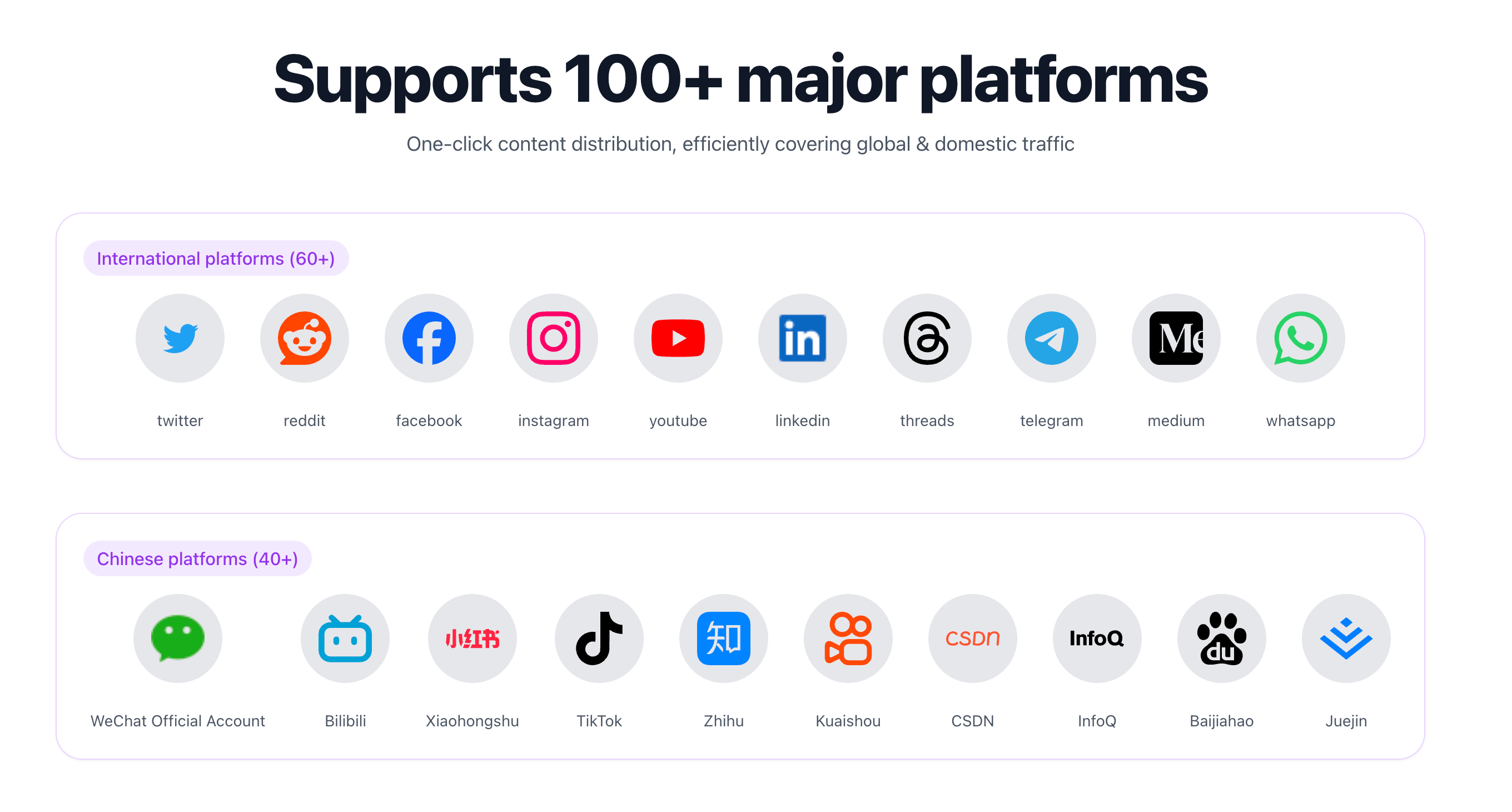
That’s why we ultimately incorporated SEONIB Flow into our workflow. It doesn’t try to do what it’s not good at (like understanding context and rewriting); instead, it precisely solves a deterministic problem: how to take a ready‑made piece of content (title, body, images, tags) and convert it according to each platform’s technical format requirements (WordPress, Medium, LinkedIn Article, Twitter Thread, etc.), then push it to the publishing interface for my final confirmation. This positioning is crystal‑clear and gives us confidence.
Specific Pitfalls and Decisions When Building an Automated Workflow
Building an automation pipeline sounds smooth, but when you actually deploy it you encounter a host of details not covered in textbooks. For example, image handling. A blog may contain five images; some platforms support carousel galleries, others only display the first image, and some have strict size requirements. Should the automation tool compress, crop, or upload the original images? What if the original files are too large and cause slow loading, hurting user experience? We initially ran into blurry images on a platform because the default compression ratio used during conversion was inappropriate.
Another pitfall is links and UTM parameters. To track traffic sources, we usually add UTM tags to URLs. During automated distribution, do we use the same UTM source for every platform (e.g., utm_source=automated_distribution) or generate independent parameters per platform (e.g., utm_source=linkedin_auto, utm_source=twitter_auto)? The former is simple to analyze but can’t differentiate platform performance; the latter yields finer data but is harder to manage and prone to errors. We settled on a compromise: SEONIB Flow injects a predefined, platform‑specific UTM template at distribution time. This preserves tracking granularity while avoiding the inefficiency and mistakes of manual handling.
Publishing timing strategy also deserves deep thought. Should we publish at perfectly even intervals, or schedule intelligently based on platform activity windows? We started with a simple “now + delayed queue” approach, but the results weren’t ideal. Later, using historical data we set different “optimal publishing windows” for each platform, allowing Flow to schedule posts automatically within those windows. The key is that the automation tool must be flexible enough to let you define such rules rather than enforcing a rigid fixed interval.
Safety Gate: Why the Final Confirmation Step Is Indispensable
Even with high automation, we always insert a “human confirmation” step before final publishing. This is the lifeline for account safety. There are three reasons:
- Instant platform rule changes – What’s allowed today may be deemed a violation tomorrow. Automation can’t keep up with every policy update in real time.
- Contextual mismatch risk – While the core content stays the same, a topic may become sensitive due to a concurrent social event. Only a human can make that contextual judgment.
- Final quality check – Automated conversion can produce unexpected formatting glitches, such as code snippets rendering incorrectly on a platform or broken image links. A last glance prevents embarrassment.
SEONIB Flow’s design embodies this philosophy. After completing all heavy format‑adaptation and push tasks, it presents the pending content in each platform’s native editor, waiting for me to log in and click the final “Publish” button. This usually takes only a few minutes of quick browsing, but the peace of mind it provides is huge. It lets me confidently set up a week‑ or month‑long distribution queue without worrying that some odd‑hour post will go out at the wrong time.
What Did We Gain After Automation?
Six months after implementing the automated distribution workflow, the most obvious change was time. I reduced roughly ten hours of weekly manual work to under one hour spent on strategy and final confirmation. More importantly, it brought predictability and scalability.
Content publishing is no longer a series of anxiety‑inducing to‑do items on my calendar; it’s a stable background process. This allows my team to focus on the actual creation of content and higher‑level strategic analysis, such as: which content types perform best on which platforms? How does timing affect engagement rates? With clean, on‑time data accumulated from consistent publishing, we can conduct these analyses.
Of course, automation isn’t “set it and forget it.” We still regularly review the workflow, tweak it based on new platform features (e.g., the rise of Threads), performance data, and team feedback. The adjustments target strategy and rules, not the repetitive actions themselves.
FAQ
Q: Will automated distribution make my content look the same on every platform and feel stale?
A: It depends on your setup. Automation handles “搬” and “format conversion,” not “content creation.” You can prepare different introductions, conclusions, or topic tags for each platform before distribution, and the automation tool will execute those differentiated instructions. The key is that you control the differentiated parts, while the tool handles the repetitive work.
Q: For a startup, is it necessary to build an automated workflow from the start?
A: It depends on publishing frequency and the number of platforms. If you post only 1–2 pieces per week across 2–3 platforms, manual handling might be tolerable. But once you aim for a steady cadence (daily or multiple times per week) or cover more than three platforms, the error rate and time cost of manual work rise sharply. Building automation early actually lays the foundation for future content scaling.
Q: Besides saving time, what indirect benefits does automated distribution bring?
A: The biggest indirect benefit is clearer team collaboration. An automated workflow defines clear responsibility boundaries: creators produce content, operators set distribution rules and give final approval. This reduces communication overhead and makes deliverables (like publishing schedules and platform performance reports) more transparent and measurable.
Share Article